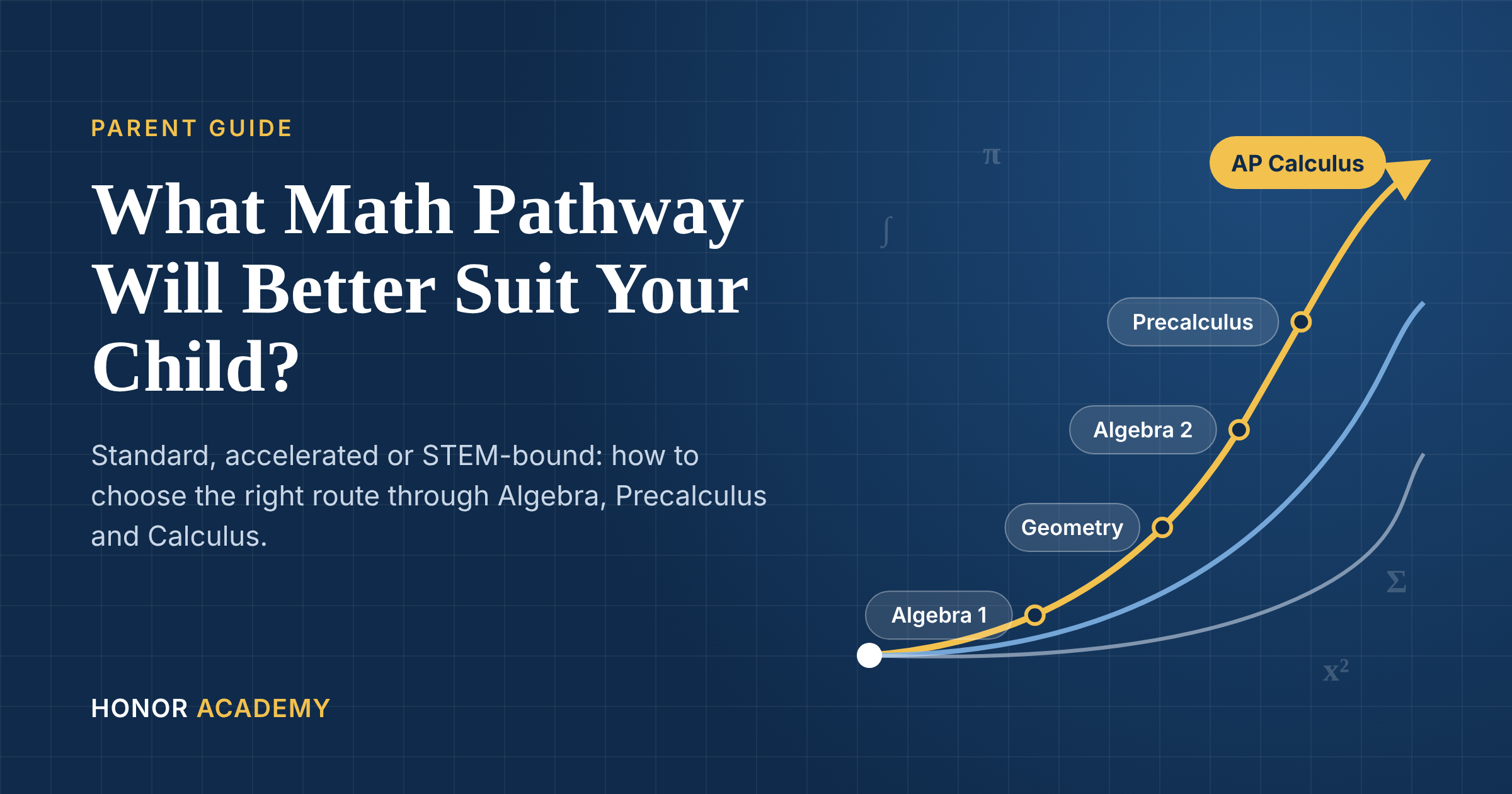
The right math pathway is the one your child can finish strong. That usually means reaching the course their future goals need, often calculus for STEM-minded students, without rushing past the foundations that make advanced math possible.
For many Southern California families, the question comes up sooner than expected. Placement decisions start as early as 5th or 6th grade, and the course a student takes in 8th grade shapes what they can reach by senior year. At the same time, UC professors have raised concerns that more incoming freshmen arrive unprepared for college-level math. In other words, the goal is not just to move fast. It is to move well.
This guide walks through the main pathways in California schools, what colleges actually expect, and how to tell which route fits your child.
The main pathways in California schools
The biggest difference between pathways is when a student takes Algebra 1. That one course sets the pace for everything after it.
- Standard pathway: Math 6, 7 and 8 in middle school, then Algebra 1 in 9th grade, Geometry, Algebra 2 and Precalculus. Students finish with Precalculus as seniors. It fully meets UC and CSU requirements.
- Accelerated pathway (Algebra 1 in 8th grade): Students compress middle school math, often through a compacted course such as Irvine Unified’s Enhanced Math 7/8, and take Algebra 1 in 8th grade. That leaves room for Calculus by senior year.
- Highly accelerated (Algebra 1 in 7th grade or earlier): A smaller group moves even faster and can reach AP Calculus BC as juniors, with multivariable calculus or advanced statistics as seniors. A rare few, usually those who start Algebra 1 in 6th grade, reach BC as sophomores.
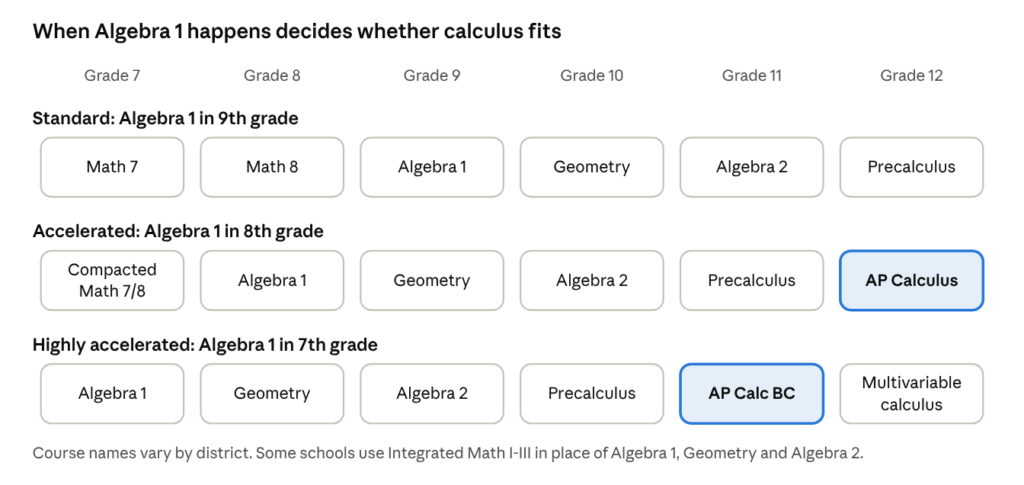
Each year earlier that a student starts Algebra 1 adds a year of room at the top, which is what makes calculus possible before graduation.
A few other terms you may hear:
- Traditional vs. Integrated: Some high schools teach Algebra 1, Geometry and Algebra 2 as separate courses. Others use Integrated Math I, II and III, which blend the same topics each year. Colleges treat them as equivalent.
- Catching up later: Some students accelerate in high school by doubling up (for example, Geometry and Algebra 2 in the same year) or through a summer course. Policies vary widely. Some districts do not accept outside courses for placement, so check before you enroll.
- Senior-year options: After Precalculus or Algebra 2, students may choose AP Calculus AB or BC, AP Statistics, or newer data science courses. Since fall 2025, UC does not accept data science or AP Statistics as a substitute for Algebra 2.
Each district sets its own placement rules. Since 2016, California law (the Mathematics Placement Act) has required districts to use multiple objective measures for 9th-grade placement, recheck placement within the first month of school, give families a way to appeal, and post the policy online. Districts set their own policies for middle school placement, and the rules differ a lot from one district to the next.
The question is also getting renewed attention. In March 2026, San Francisco Unified voted to bring Algebra 1 back to every middle school starting in 2026–27, more than a decade after largely removing it.
What colleges actually expect
Few colleges strictly require calculus, but the most selective ones expect students to take the most rigorous math their school offers, and STEM applicants are usually expected to reach calculus.
- University of California and CSU: Require three years of math (Algebra 1, Geometry and Algebra 2, or Integrated Math I–III) with a C or better, and recommend a fourth year. Students aiming for STEM majors typically go further, toward calculus.
- MIT: Looks for two semesters of calculus, though students can also show mastery through outside coursework or an exam.
- Caltech: Dropped calculus as a required high school course in 2023, but still expects applicants to show mastery of calculus, for example through online courses.
- Stanford: Recommends four years of rigorous math and welcomes calculus and statistics.
- Princeton, Carnegie Mellon and Purdue: Strongly recommend or encourage calculus for at least some applicants.
- Cornell: In a 2024 survey of 20 top schools, the only one that still required calculus.
The pattern matters more than any single rule. Admissions readers look at what your school offered and how far your student went. A student whose school offers AP Calculus BC but who stops at Precalculus will stand out less for STEM programs than one who took the challenge and did well.
There is also a readiness side to this. In 2026, more than 1,400 UC faculty asked the university to bring back SAT or ACT math scores for STEM applicants. They pointed to rising numbers of freshmen placing below college-level math at UC San Diego, UC Davis and UC Berkeley. Strong foundations, not just advanced course titles, are what carry students through college math.
If your child isn’t headed for STEM
Students interested in the humanities, social sciences, law or the arts don’t need to race to calculus, but they still need four strong years of math. Selective colleges read a transcript for rigor in every subject, and math is no exception.
- Take math all four years. UC requires three years and recommends four. Dropping math senior year can look like a step back, even for a future English or history major.
- The standard pathway is a fine choice. A student who takes Algebra 1 in 9th grade and earns strong grades through Precalculus is well prepared. There is no need to accelerate just to keep up with friends.
- Choose a meaningful senior-year course. AP Statistics is a strong fit for students drawn to psychology, sociology, political science, public policy or journalism, fields built on data and research. AP Precalculus or AP Calculus AB are good choices for students who want to keep more doors open.
- Don’t skip Algebra 2. UC no longer accepts AP Statistics or data science in place of Algebra 2, so statistics should come after it, not instead of it.
- Watch for majors that need calculus. Economics and business are not STEM majors, but they often require calculus in college. At UCLA, for example, the economics major starts with two quarters of calculus and a statistics course. A student considering these fields should aim to reach calculus in high school.
- Keep the SAT in mind. Many highly selective colleges require test scores again, and the math section counts for every applicant, STEM or not.
Interests often change in high school. A path that keeps calculus within reach costs little and protects your child’s options if they discover a love for economics, data or science later on.
How to tell which pathway fits your child
A child is ready to accelerate when they understand the current material deeply, not just when they get good grades. The best signal is how they handle problems they haven’t seen before.
Signs your child may be ready to accelerate:
- They earn strong grades without extensive outside help, and those grades match their test results.
- They can explain why a method works, not just follow the steps.
- They are comfortable with fractions, negative numbers and multi-step word problems, the building blocks of algebra.
- They enjoy a challenge and keep going when a problem is hard.
- They have time and energy for a faster pace alongside their other commitments, like debate, music or sports.
Signs it may be better to slow down or strengthen first:
- High grades depend heavily on tutoring right before tests, and the material fades soon after.
- They make frequent mistakes with arithmetic or fractions, even when they understand the big idea.
- Math has become a source of stress or tears, not just a hard subject.
- They are being pushed ahead mainly because friends are.
The cost of rushing is real. A student who is moved ahead too soon may struggle in Algebra 2 or Precalculus, and a low grade there can hurt a college application more than a later start would have.
The reverse is also true. A capable student left in a pace that’s too slow can lose interest and miss the calculus that STEM programs look for. The right choice depends on your child, not on what other families are doing.
Key decision points, grade by grade
Most placement decisions happen in spring, often through a test or a score cutoff, so the time to prepare is the fall and winter before.
| Grade | What usually happens | What parents can do |
|---|---|---|
| 5th–6th | Many districts screen for advanced or compacted middle school math using state test scores, district tests and grades. | Learn your district’s criteria and testing dates early. Strengthen fractions, ratios and problem solving. |
| 7th | Placement for Algebra 1 in 8th grade is decided, often by a spring test, with a summer bridge as a second chance in some districts. | Ask whether a summer bridge or an appeal exists, and what the cutoff is. |
| 8th | High school placement is set. Algebra 1 on an 8th-grade transcript usually means Geometry in 9th. | Make sure your child truly mastered Algebra 1. Repeating it is better than struggling through Geometry and Algebra 2. |
| 9th–10th | The last practical window to accelerate, through doubling up or approved summer courses. | Map out the four-year plan backward from the senior-year course your child wants. |
Questions to ask your school or district:
- What measures do you use for placement, and what are the cutoffs?
- Is there a summer bridge, a retest or an appeal if my child just misses the cutoff?
- Do you accept outside courses or tests for placement?
- If my child starts on the standard pathway, can they still reach calculus? How?
- If an accelerated course turns out to be too fast, can my child move back without losing ground?
The bottom line
There is no single “right” pathway, only the one that fits your child’s readiness and goals. A student who takes Algebra 1 in 9th grade and masters it can still build a strong application. A student who accelerates without solid foundations often pays for it later.
What matters most is an honest look at where your child is now, a plan that works backward from their goals, and steady support along the way. College policies also change, so check each school’s admissions page as your child gets closer to applying.
Not sure which pathway is right for your child? Honor Academy’s math tutoring program helps students in Cerritos and across Southern California prepare for placement tests, strengthen foundations before accelerating, and stay confident as the pace picks up. Schedule a consultation and we’ll help you map out a math plan that fits your child.
For more on how to think about math ability, see our earlier post, Is your child a “math person”?
Sources
- EdSource: UC confirms data science can’t substitute for Algebra II (March 2024)
- EdSource: UC freshmen increasingly not ready for college math (June 2026)
- The 74 / LA School Report: Caltech drops calculus requirement, others still expect it (January 2024)
- California SB 359, Mathematics Placement Act of 2015
- SFUSD: Board approves revised math placement policy (March 2026)
- Cuemath: How California districts decide Algebra 1 in 8th grade