Is your child a “math person”? Here is what actually predicts STEM fit — and why the answer is not as fixed as you thin
June 17, 2026
By Honor Academy · Orange County and Los Angeles County, CA · Academic Tutoring & STEM Preparation
Every parent of a school-age child has wondered it at some point. Is my child a math person? Are they wired for STEM, or are they better suited for something else? It is a natural question — and it matters, because the answer shapes course selections, extracurricular choices, and eventually college and career direction.
Here is what we want every Orange County and Los Angeles County parent to know before drawing that conclusion: the “math person” framing is mostly a myth, and relying on it too early can do real damage. What actually predicts STEM fit is not some fixed trait your child was born with. It is a specific combination of observable behaviors — and importantly, the real answer to whether a student is built for STEM usually does not reveal itself until Pre-Calculus or Calculus, not Algebra. Pushing a child into that answer too early, by accelerating them years ahead of where their thinking has actually matured, often produces the opposite of what parents are hoping for.
Let us walk through both halves of this carefully.
Why “math person” is the wrong question
Decades of research in cognitive science and education have converged on a clear finding: math ability is not a fixed trait that some children have and others lack. It is built — through practice, instruction quality, mindset, and the gradual development of abstract reasoning. Students who struggle with math in elementary school are not destined to struggle with it forever. Students who excel early are not guaranteed to excel later. The brain’s capacity for mathematical and abstract thinking develops over time, and it develops differently for different students.
This matters enormously for how parents should think about this question. A six-year-old who is slow to pick up arithmetic is not revealing some permanent truth about their relationship with mathematics. A ten-year-old who breezes through multiplication tables is not guaranteed a future in engineering. What we should actually be watching for are behaviors and patterns that tend to predict genuine STEM engagement — not snap judgments based on how quickly a child computes.
The observable signs worth watching for
Rather than asking “is my child a math person,” a more useful question is: does my child show these specific behaviors when they encounter mathematical or scientific problems?
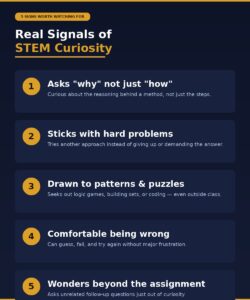
Genuine curiosity about why, not just how. A child who asks “but why does that work?” after learning a method — rather than simply memorizing the steps and moving on — is engaging with mathematics at a deeper level. This curiosity about underlying structure is one of the strongest predictors of long-term STEM engagement, because STEM fields are fundamentally about understanding why systems behave the way they do.
Persistence with difficult problems. Watch how your child responds when a problem does not yield an answer quickly. Do they get frustrated and disengage, or do they try a different approach? Productive struggle — the willingness to sit with difficulty and try multiple strategies rather than giving up or demanding the answer — is a far better predictor of STEM success than how quickly a child solves easy problems.
Enjoyment of patterns and puzzles. Children drawn to STEM often gravitate toward pattern recognition activities outside of formal math class entirely — puzzles, strategy games, building sets, coding games, or noticing numerical patterns in everyday life. This kind of voluntary engagement with structure and logic, happening outside of homework requirements, is a meaningful signal.
Comfort with being wrong. Mathematics and science both require generating hypotheses, testing them, and being wrong frequently along the way. Students who can make an attempt, get it wrong, and try again without significant emotional distress tend to thrive in STEM disciplines, because that cycle is the actual daily experience of doing math and science at any serious level.
Asking questions that go beyond the assignment. A student who finishes a worksheet and starts wondering about a related but unassigned question — what happens if the numbers were negative, what would this look like in three dimensions, why does this formula work for circles but not other shapes — is demonstrating the kind of self-directed intellectual curiosity that defines successful STEM students far more reliably than grades alone.
None of these signs require a child to be precocious or unusually fast. They describe a way of engaging with problems — one that can be present in a child who takes longer to find the right answer just as easily as in one who finds it quickly.
Why Pre-Calculus and Calculus are the real moment of truth
Here is the part many parents do not anticipate. Algebra, Geometry, and even Algebra 2 are largely procedural courses. Success in these classes depends heavily on practice, pattern memorization, and careful execution of multi-step processes. A student can perform very well in these courses through diligence and good instruction, even if their capacity for genuinely abstract mathematical reasoning has not yet caught up.
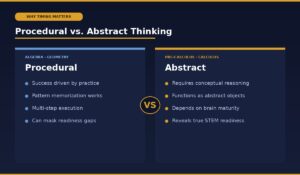
Pre-Calculus and Calculus are different. They require students to reason about functions as abstract objects, to understand the behavior of systems as they approach limits, to hold multiple interacting variables in mind simultaneously, and to think about mathematics conceptually rather than procedurally. This level of abstract reasoning depends substantially on cognitive and neurological maturity that develops with age — not just with practice. It is genuinely the point at which a student’s underlying capacity for STEM thinking becomes visible in a way it simply was not in earlier courses.
This is also why we encourage real caution about accelerating students more than a year or two ahead of grade level, particularly into Pre-Calculus or Calculus. A student who is pushed into these courses before their brain has had the typical developmental runway to build abstract reasoning capacity is not actually getting an accurate read on whether they are suited for STEM. They are being tested on material their thinking may not yet be ready to engage with conceptually — and the result is often a student who works extremely hard, relies heavily on memorized procedures rather than genuine understanding, and experiences significant stress while still earning a mediocre result.
That outcome is genuinely worse than the alternative. A student who takes Calculus at the typical pace — after their reasoning has had time to develop — and performs well is getting an honest, meaningful signal about their STEM aptitude. A student who was rushed into Calculus early and struggled is getting a false negative. They may conclude they are “not a math person” when the real issue was simply timing, not capability.
What this means practically for SoCal families
If your child is showing the behavioral signs of mathematical curiosity and engagement we described above, the best path is rarely to rush them as far ahead as possible. It is to build genuine depth at an appropriate pace — making sure each concept is truly understood before moving to the next one — so that when they do reach Pre-Calculus and Calculus, whether at the standard timeline or modestly ahead, they are encountering that material with a brain and a foundation actually ready to engage with it conceptually.
This is also why the question of whether your child’s school offers an advanced math track matters so much, a point we have written about before. A student progressing through a school’s own Honors sequence one year ahead — with the conceptual depth and pacing that a well-designed course provides — is in a very different position than a student privately rushed two or three years ahead through procedural acceleration alone.

The honest answer to “is my child a math person” usually cannot be given with confidence in elementary or middle school. It becomes clear later — at Pre-Calculus and Calculus — and it becomes clearest of all when a student reaches that point with their reasoning genuinely ready for it, rather than rushed there before they were prepared.
Our recommendation
Watch for curiosity, persistence, comfort with difficulty, and self-directed questioning — these are the real signals worth paying attention to, far more than speed or early grades. Build deep understanding at each stage rather than racing ahead. And give your child’s reasoning the time it needs to mature before judging their long-term fit for STEM based on how Pre-Calculus or Calculus goes. A student who struggles with Calculus because they were pushed there too early has not learned anything true about their own aptitude. A student who reaches it at the right time, with real understanding underneath them, finally gets an honest answer.
Honor Academy supports students across Orange County and Los Angeles County — Fullerton, Cerritos, Cypress, Los Alamitos, Anaheim, Irvine, Brea, Los Angeles, Yorba Linda, Placentia, Buena Park, La Palma, Artesia, and Garden Grove — in building exactly this kind of genuine mathematical foundation, with small group and private tutoring designed around real conceptual understanding rather than rushed acceleration.
Frequently asked questions
How do I know if my child is a “math person”?
Math ability is not a fixed trait — it develops through practice, instruction, and maturing abstract reasoning. Rather than looking for a fixed label, watch for behavioral signs: curiosity about why methods work, persistence with difficult problems, enjoyment of patterns and puzzles, comfort with being wrong, and self-directed questions that go beyond assigned work.
What math class reveals whether a student is suited for STEM?
Pre-Calculus and Calculus are typically the clearest indicators, because they require abstract conceptual reasoning rather than the procedural skills that dominate Algebra and Geometry. A student’s performance in these courses, taken at an appropriate pace, gives a far more honest signal of STEM aptitude than earlier math grades.
Is it harmful to accelerate a child too far ahead in math?
It can be. Pushing a student more than a year or two ahead, particularly into Pre-Calculus or Calculus before their abstract reasoning has matured, often leads to reliance on memorized procedures rather than genuine understanding, increased stress, and a result that does not accurately reflect the student’s real capability or potential.
Does Honor Academy help determine if a child is ready for advanced math?
Yes. Honor Academy’s tutoring approach in Orange County focuses on building genuine conceptual understanding at each stage of a student’s math education, helping families make informed decisions about pacing and acceleration rather than rushing ahead based on early grades alone.