Why Debaters Excel at FBLA, Mock Trial, and Model UN
There is a pattern we have noticed at Honor Academy over the years — one that tells you more about the power of debate training than any tournament result ever could.
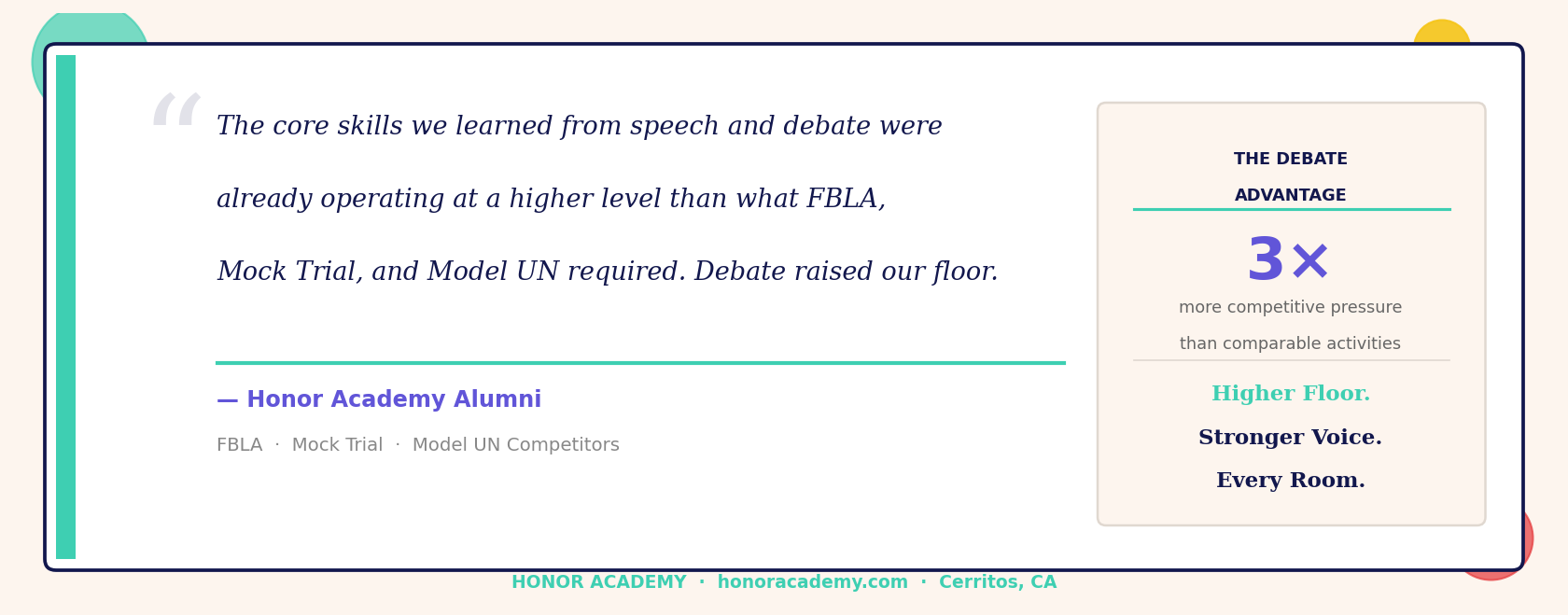
Some of our students were not the top finishers on the debate circuit. Their win-loss records were respectable, not spectacular. But when those same students participated in FBLA, Mock Trial, and Model UN, something interesting happened: they rose to the top. Quickly. And when they graduated from high school, they told us the same thing, almost word for word — that the core skills they had learned through speech and debate were already operating at a higher level than what FBLA, Mock Trial, or MUN required. Debate had raised their floor, even when the trophies did not always reflect it.
That is the real story of what debate training does. It builds a foundation so strong that students perform above their competition in every arena where thinking, speaking, and persuading matter — which turns out to be almost every arena that counts.
FBLA — Future Business Leaders of America
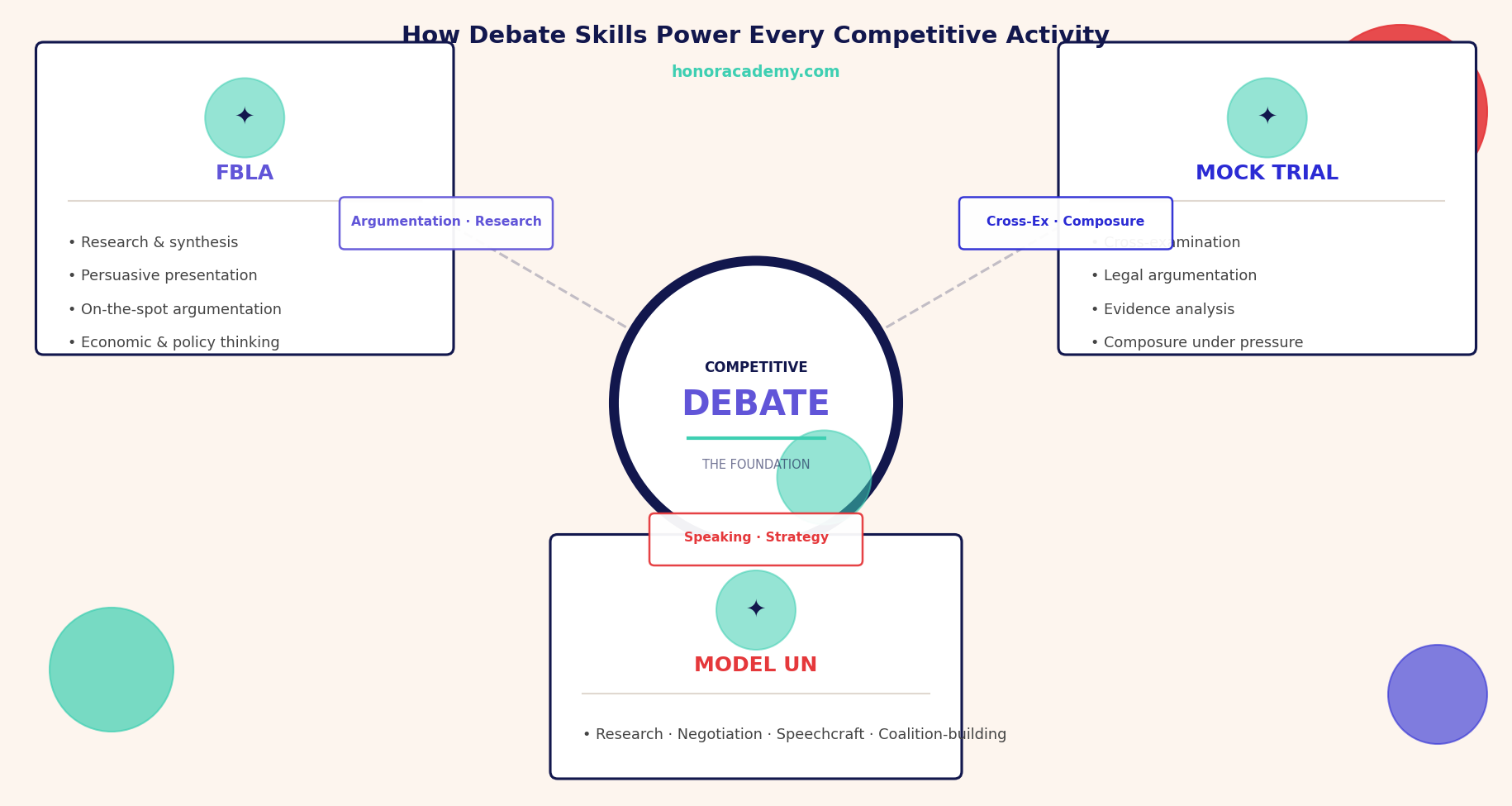
FBLA competitions reward students who can walk into a room, present an idea clearly, and hold their ground when challenged. Whether it is a case study event, a business plan presentation, or an impromptu economics challenge, the students who rise to the top are almost always the ones who can structure an argument on their feet and speak with confidence under pressure.
Debate students do that every week.
Public Forum debaters routinely read economic reports, analyze policy data, and distill complex information into persuasive arguments — often in the same week they are expected to defend the opposite side. By the time a trained debater steps into an FBLA event, the pressure of the room feels familiar. The judges feel manageable. The questions feel answerable. They have already done something harder.
Research habits also transfer. FBLA rewards students who can synthesize information quickly and present it credibly. That is not a skill most students develop in a classroom. It is a skill developed through debate preparation, where research is not optional and vague arguments lose rounds.
Mock Trial
Mock Trial is debate’s closest relative, and the crossover is almost direct.
Students take on roles as attorneys and witnesses, construct legal arguments, examine evidence, and respond to opposing counsel in real time. Every one of those tasks maps directly onto skills that competitive debaters have already practiced hundreds of times.
Cross-examination — the hardest part of Mock Trial for most students — is something debaters train in constantly. They learn how to ask pointed questions, how to control a line of questioning without tipping their hand, and how to stay composed when the other side pushes back. Those skills show up immediately on the Mock Trial floor.
Debaters also know how to read a room. They have learned to adjust their tone, pacing, and approach based on who is in front of them — a critical skill when performing in front of real attorneys and judges. And they are comfortable with the unexpected. They have argued positions they did not choose, responded to arguments they had never seen before, and stayed composed when the round went sideways. In Mock Trial, that composure is often the deciding factor.
Model United Nations
Model UN is where debate meets diplomacy — and debaters are exceptionally well-prepared for it.
MUN requires students to research a country’s position, draft resolutions, negotiate with other delegations, deliver floor speeches, and respond to challenges in real time — all while representing a perspective that is not their own. That is a description of what a competitive debater does every round.
The research burden in MUN is significant, and most students find it overwhelming. Debaters do not. They have already developed the habit of processing large volumes of information quickly, identifying the strongest arguments on multiple sides, and turning that research into a coherent position. MUN position papers, which many students struggle with, come naturally to students who have written constructive cases for both sides of a resolution.
Public speaking confidence is the other major differentiator. Many students find the idea of addressing a full committee of delegates intimidating. Debaters have addressed judges and audiences in far higher-pressure environments. By the time they walk into a MUN conference, the room feels smaller — and their presence in it feels larger.
Why Debate Builds the Highest Floor
What FBLA, Mock Trial, and MUN all share is that they reward the same core abilities: the ability to research deeply, think clearly, speak confidently, and persuade effectively under pressure. These are not talents students are born with. They are skills — and they are exactly what competitive debate develops.
The reason our students who competed in all four activities performed above their peers in FBLA, Mock Trial, and MUN is not because debate is easier. It is because debate is harder. The standards are higher, the pressure is more intense, and the feedback is more immediate. Students who train in that environment and then step into a Model UN conference or a Mock Trial courtroom find that they have already built the muscles everyone else is still trying to develop.
That is what those graduating students meant when they told us that debate had prepared them at a level beyond what those other programs required. They were not diminishing FBLA or Mock Trial or MUN. They were describing what real foundational training does: it raises the floor so high that the ceiling of other activities is already within reach.
At Honor Academy, we serve students across Fullerton, Cerritos, Cypress, Los Alamitos, Anaheim, Irvine, Brea, Los Angeles, Yorba Linda, Placentia, Buena Park, La Palma, Artesia, and Garden Grove. Our alumni have gone on to top colleges in the US including Harvard, Cornell, Brown, Princeton, Yale, Rice, USC, UCLA, Williams College, Claremont McKenna, Emory, West Point, Johns Hopkins, Stanford, and NYU. Many of them were not the top debate finishers in the room. But they were among the most prepared students in every room they walked into after.
We want our students to have a VOICE not an ECHO — and once they find that voice through competitive debate, it carries into every room they enter, whether that room is a boardroom simulation, a courtroom, a United Nations conference, or a college admissions interview.
If your student is involved in or considering FBLA, Mock Trial, or Model UN, debate training is the single best investment you can make in their competitive preparation. We would love to show you what that looks like at Honor Academy.