How speech and debate builds the exact skills AP English and AP US History reward
June 23, 2026
By Honor Academy · Los Angeles County, Orange County, CA · Speech & Debate and Academic Tutoring
Every May, hundreds of thousands of students sit down to write AP English Language, AP English Literature, and AP US History exams — and the single biggest factor separating a 3 from a 5 is rarely raw subject knowledge. It is the ability to build an argument, support it with well-chosen evidence, and write it under serious time pressure in a way that is clear, organized, and persuasive.
That is also, almost exactly, the skill set that competitive speech and debate builds every single week.
This is not a loose analogy. The overlap between what AP readers are trained to reward and what debate coaches spend years training students to do is direct and specific. Here is exactly how they connect — subject by subject, skill by skill.
What AP readers are actually scoring
The College Board trains AP English and AP History readers using detailed rubrics, and those rubrics reward a consistent set of things regardless of the specific prompt: a clear, defensible thesis; evidence that is specific and relevant rather than vague; reasoning that explains why the evidence supports the thesis, not just that it does; awareness of complexity and counterargument; and an organized structure that a reader can follow without getting lost.
Notice that none of this is really about “knowing more facts.” A student who has memorized every date in the American Revolution can still score a 2 on the AP US History DBQ if they cannot build an argument with that knowledge. A student with strong opinions about a novel can still score poorly on AP Literature if they cannot organize those opinions into a structured, evidence-backed case. The exam is fundamentally testing argumentative construction — and that is exactly what debate trains, every single tournament, for years.
The direct skill overlap, point by point
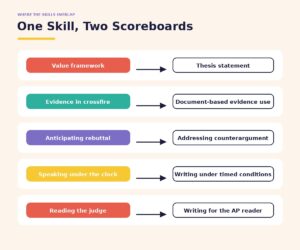
Thesis and framework construction. In Lincoln-Douglas debate, students build a value framework before they ever get to specific arguments — they have to establish what standard the judge should use to evaluate the round. This is structurally identical to building a strong thesis statement that frames how an entire essay will be evaluated. A debater who has spent two years writing value framework after value framework walks into an AP essay prompt already fluent in the exact intellectual move the exam is asking for: state a clear, arguable position before diving into support.
Evidence selection and use. Public Forum debate requires students to find, evaluate, and deploy evidence under real time pressure — separating strong sources from weak ones, and using evidence precisely rather than just dropping a quote and moving on. This is the single skill AP readers most consistently say students lack. Essays that simply summarize a document instead of using it as evidence for an argument are the most common reason DBQs score lower than they should. Debaters have already drilled the difference between citing evidence and actually using it, because in a debate round, evidence that does not clearly support your claim gets torn apart by an opponent within seconds.
Counterargument and complexity. Every competitive debate round requires anticipating the other side’s strongest response and addressing it before it is even raised. This is precisely what earns the highest band on AP rubrics — demonstrating “sophistication” by engaging with complexity and tension rather than presenting a one-sided argument. A debate-trained student does not need to be taught to consider the counterargument. It is the most basic habit of how they already think about any claim.
Writing and arguing under time pressure. AP exams are notoriously stressful because of the clock — 40 minutes for a DBQ, 40 minutes for a synthesis essay, with no time to draft, revise, and rewrite the way a take-home essay allows. Debaters write cases, rebuttals, and closing arguments under similarly tight constraints constantly — and more importantly, they have to think clearly under direct pressure in front of a judge, which is a much higher-stakes and more public form of time pressure than a quiet exam room. Students who are used to organizing a persuasive argument in their head in two minutes for a debate round do not panic when given 40 minutes to write one.
Audience awareness. Debate requires constant calibration to the judge in the round — a skill we have written about before in the context of traditional versus progressive debate. AP readers are, in a very real sense, the “judge” of an exam essay, and students who have spent years learning to write and speak for a specific audience instinctively produce essays that anticipate what an evaluator is looking for, rather than writing in a vacuum.

Why this matters specifically for AP US History
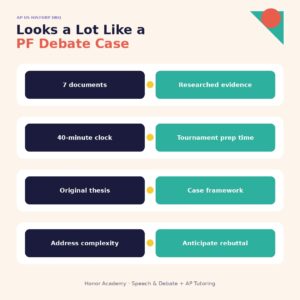
AP US History deserves a particular note because of the Document-Based Question, or DBQ — widely considered one of the hardest tasks on any AP exam. The DBQ requires students to synthesize seven historical documents into an original argument, addressing context, corroboration, and historical complexity, all in 40 minutes including reading time.
This is, structurally, almost identical to a Public Forum debate case built from researched evidence under a tight prep clock. A PF debater spends a season building cases by synthesizing multiple sources into a coherent argument with a clear thesis and supporting structure — then has to adapt and rebuild that argument on the fly against a different opponent’s framing. Students who have done this dozens of times over a season do not encounter the DBQ format as something unfamiliar. They encounter it as a slightly different version of something they already do well.
Why this matters specifically for AP English
AP English Language and AP English Literature both reward what the College Board calls “line of reasoning” — the ability to build an argument that develops logically from one point to the next, rather than a list of disconnected observations. This is exactly the skill a Lincoln-Douglas debater builds when constructing a case: each contention has to connect back to the framework, and each piece of evidence has to connect back to the contention, forming a single coherent chain rather than a pile of separate points.
Original Oratory students, in particular, develop an unusually strong sense of rhetorical craft — the deliberate use of structure, repetition, and persuasive technique to make an argument land emotionally as well as logically. That is precisely the skill AP English Language’s rhetorical analysis questions are testing for, except in reverse: instead of analyzing someone else’s rhetorical choices, the debate student has spent years making those choices themselves, which gives them an intuitive, practiced understanding of why certain rhetorical moves work.
What this means for Orange County families choosing between activities
Parents often think of speech and debate and AP coursework as two separate tracks — one extracurricular, one academic. The reality is that strong debate training is, in a very direct sense, AP exam preparation. A student who has spent two or three years competing in Public Forum or Lincoln-Douglas debate has been drilling thesis construction, evidence use, counterargument, and writing under pressure far more intensively than most AP prep courses ever require.
This is part of why Honor Academy has long emphasized that students research and write their own cases rather than relying on pre-written arguments. A student who has only ever recited someone else’s case has not actually built the skill. A student who has built dozens of original cases from scratch — researching the evidence, constructing the framework, anticipating the rebuttal — has done the exact cognitive work that AP exams are designed to measure.
For families across Orange County weighing how to spend a student’s limited time between competitive activities and academic preparation, this connection is worth knowing. Competitive speech and debate is not time spent away from AP success. For most students, it is some of the most direct AP preparation available — built one tournament at a time.
Frequently asked questions
Does competitive debate help with AP exam scores?
Yes. Competitive debate trains the same core skills that AP English and AP History exams reward — building a clear thesis, using evidence precisely to support an argument, addressing counterarguments, and writing persuasively under time pressure. Students with multiple years of debate experience often find AP essay formats familiar rather than intimidating.
How does debate help with the AP US History DBQ?
The Document-Based Question requires synthesizing multiple sources into an original, evidence-based argument under significant time pressure — a skill closely mirrored by Public Forum debate, where students build cases from researched evidence and adapt their argument against an opponent’s framing within a tight prep clock.
Does Lincoln-Douglas debate help with AP English essays?
Yes. Lincoln-Douglas debate trains students to build a clear framework before arguing specific points, and to connect each piece of evidence back to that framework in a single logical chain. This mirrors the “line of reasoning” that AP English Language and Literature rubrics specifically reward.
Should my child do speech and debate or focus only on AP coursework?
The two are not competing priorities. Strong debate training builds the exact argumentative, evidentiary, and writing skills that AP English and AP History exams test directly. Many Orange County families find that competitive debate functions as some of the most effective AP exam preparation available, alongside its other academic and college admissions benefits.
Does Honor Academy connect debate coaching with academic tutoring?
Yes. Honor Academy offers both competitive speech and debate coaching and academic tutoring — including AP exam preparation — for students across Orange County, including Fullerton, Cerritos, Cypress, Los Alamitos, Anaheim, Irvine, Brea, Los Angeles, Yorba Linda, Placentia, Buena Park, La Palma, Artesia, and Garden Grove. Our coaching philosophy emphasizes genuine skill-building that transfers directly across competitive and academic contexts.